
Mission
Eliminate the gap between observation and decision in real time.
The problem
Existing research tools were not built for live observation. They were built for after.
Two problems compound this:
-
Synthesis is slow and subjective
Teams over-index on memorable moments instead of seeing patterns across users and steps. -
AI summaries miss the observational layer
Transcripts lose hesitation, confusion, and in context behaviours that cannot be transcribed.
NoteSynth preserves what these approaches lose:
- Time-anchored, participant-segmented, evidence-linked observation.
- Patterns are visible during capture, not after.
- Output remains fully navigable, from summary back to the original observation.
WHO IS IT FOR
The primary user is whoever is the session observer: a PM, a researcher, an engineer pulled in last minute. NoteSynth is designed to embed a methodology without requiring one.
Applicable to usability testing, competitor analysis, expert reviews, and any structured live observation workflow. Built for small product and research teams where synthesis is a bottleneck, not a dedicated function.
WHERE THE IDEA CAME FROM
For over 15 years, I used a physical UX Wall to analyse research. Screens were printed, pinned up, and annotated in real time with colour-coded notes placed spatially near the interface element that triggered each comment.
The power came from seeing everything together: across users, across steps, in context. A stakeholder could walk in mid-project and read the room without a briefing. Note density signalled severity. Colour showed who struggled and where.
As remote work became the norm I moved the methodology into Miro and FigJam, but the manual overhead was significant and the synthesis never followed. NoteSynth is an attempt to preserve what made the wall work and to make it viable at speed, for any team.
How It Works
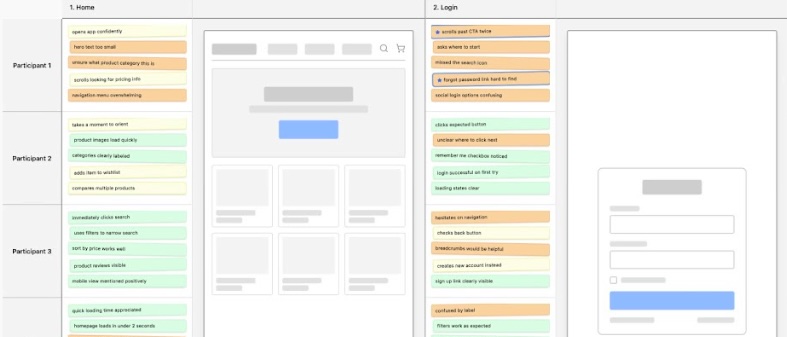
NoteSynth is built around a single constraint: capture first, interpret later. Each note is entered during the session, automatically placed on the board by journey step and participant, and silently classified by AI. No structure for the observer to maintain. No synthesis tax at the end. Signal builds while the session runs.
Design principles
Humans for input. AI for sentiment. System structure for meaning.
Speed of capture
Keyboard-first flows so notes land while the moment is still warm.
Observation before interpretation
A capture phase and a synthesis phase are kept deliberately separate.
Opinionated by design
The tool embeds a methodology, guiding observers without requiring research expertise.
Built for density
Must hold signal under real-world volume without collapsing into noise.
KEY PRODUCT DECISIONS
One note per observation
NoteSynth is designed for a narrow focus during observation. As each observation is entered, the system automatically places it on the board in the correct location. The AI reads each note and classifies it silently as positive, neutral, friction, or blocker. Over time, a signal emerges without the observer managing it.
Everything remains editable afterward. Notes can be starred, corrected, or removed, and AI categorisation can always be overridden.
Structure that speaks for itself
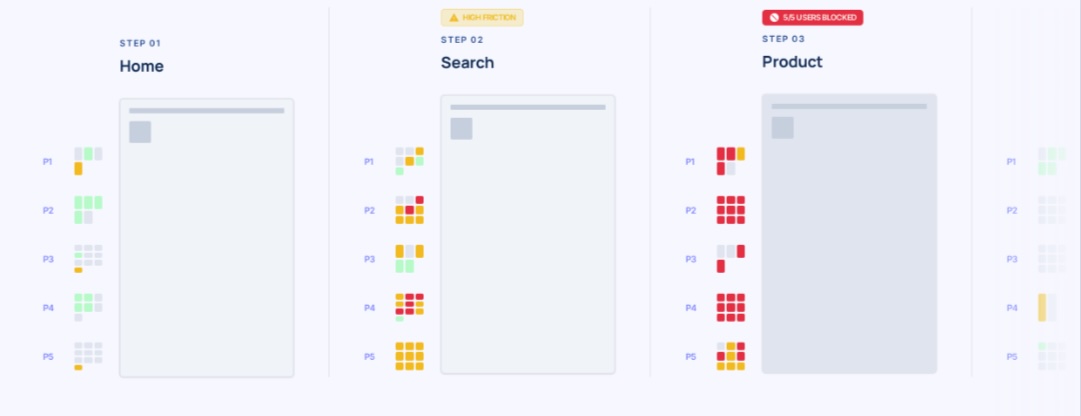
The noteboard does what the UX Wall always did by sequencing the experience and making patterns visible without effort. Participants sit in rows. Sentiment is colour-encoded. A dense cluster of red is a problem that needs no explanation. A scatter of orange is a signal worth watching. The green reminds us of what to preserve.
The board is the deliverable
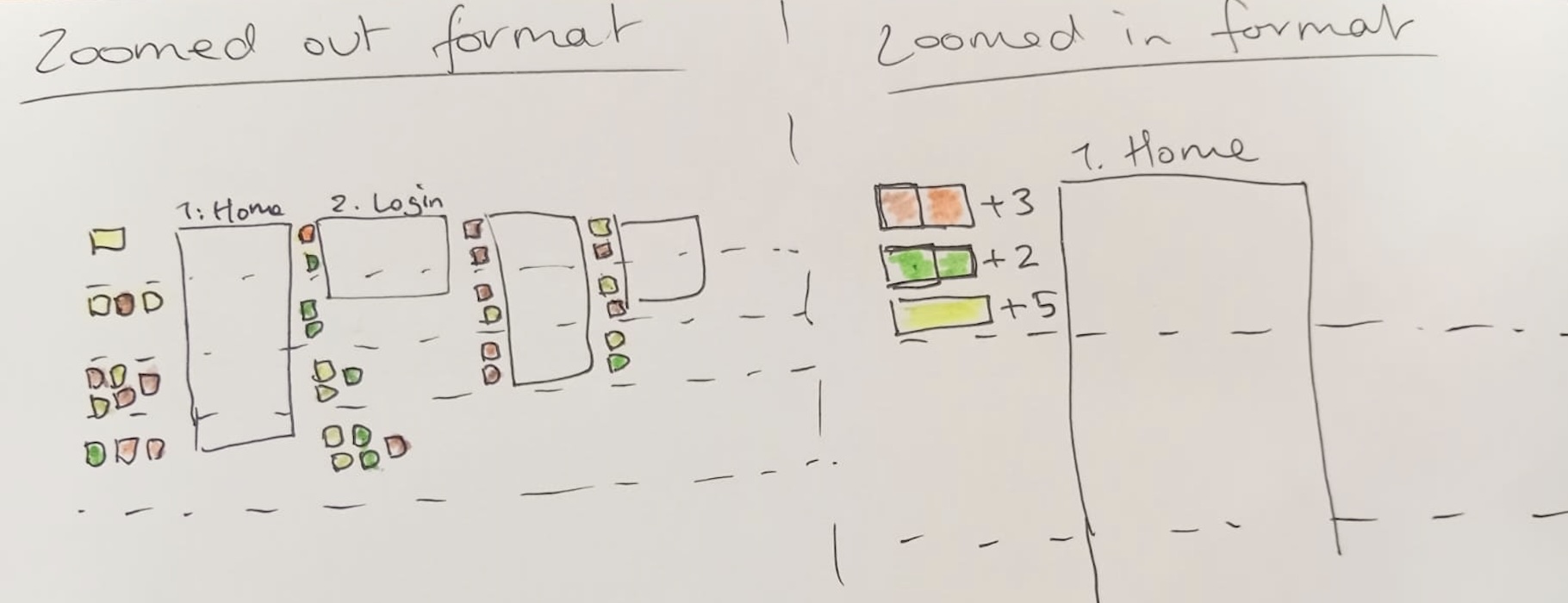
NoteSynth does not produce a report. It produces an artifact that can be zoomed into for individual notes, scanned for pattern clusters, or pulled back to show problem density across the full flow.
Progressive Synthesis
Signal builds silently throughout the session. The two-phase structure, observation first and synthesis second, is what keeps the signal clean when it matters most: during live capture.
Status
MVP built in Cursor and Vite. Moving into early user testing. Core input layer is functional. Next focus: per-step metrics, finding summaries, and force-ranked issue lists.
Stack
Closing thought
This is not a note-taking tool.
It’s a system for turning raw observation into decision-ready signal — without the synthesis bottleneck.
Appendix — the history of the UX wall
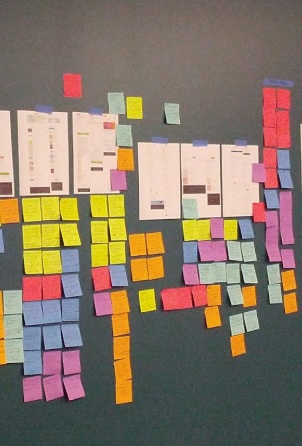
I developed this practice early in my career and brought it with me everywhere I went. During usability testing sessions, I would print screens from the prototype or live product and arrange them chronologically — pinned to a wall or spread across butcher paper — forming a visual timeline of the experience being tested.
Each participant was assigned a colour. Observers were given sticky notes in that colour and made notes in real time, placed spatially near the interface element that prompted each comment. When a pattern repeated, a plus one was added rather than a new note. After each session, the team gathered for a short debrief to capture top-of-mind observations while they were still fresh.
Every team I taught this to responded the same way. The wall worked because it was immediate and required no translation. A stakeholder could walk in mid-project and understand the shape of the problem without being briefed. Note density signalled severity. Colour showed who struggled and where. It was more engaging than any report I ever wrote.
As remote work became the norm, I moved the methodology into Miro and FigJam, but the manual overhead was significant and the synthesis never followed. NoteSynth is my attempt to preserve what made the wall work and make it viable again, at speed, for any team.